No Gravitational Anomaly in Wide Binaries from Forward Modeling of 3D Orbits
Serat M. Saad & Yuan-Sen Ting
The Open Journal of Astrophysics (2026), 9
Show abstract ▸Hide abstract ▾
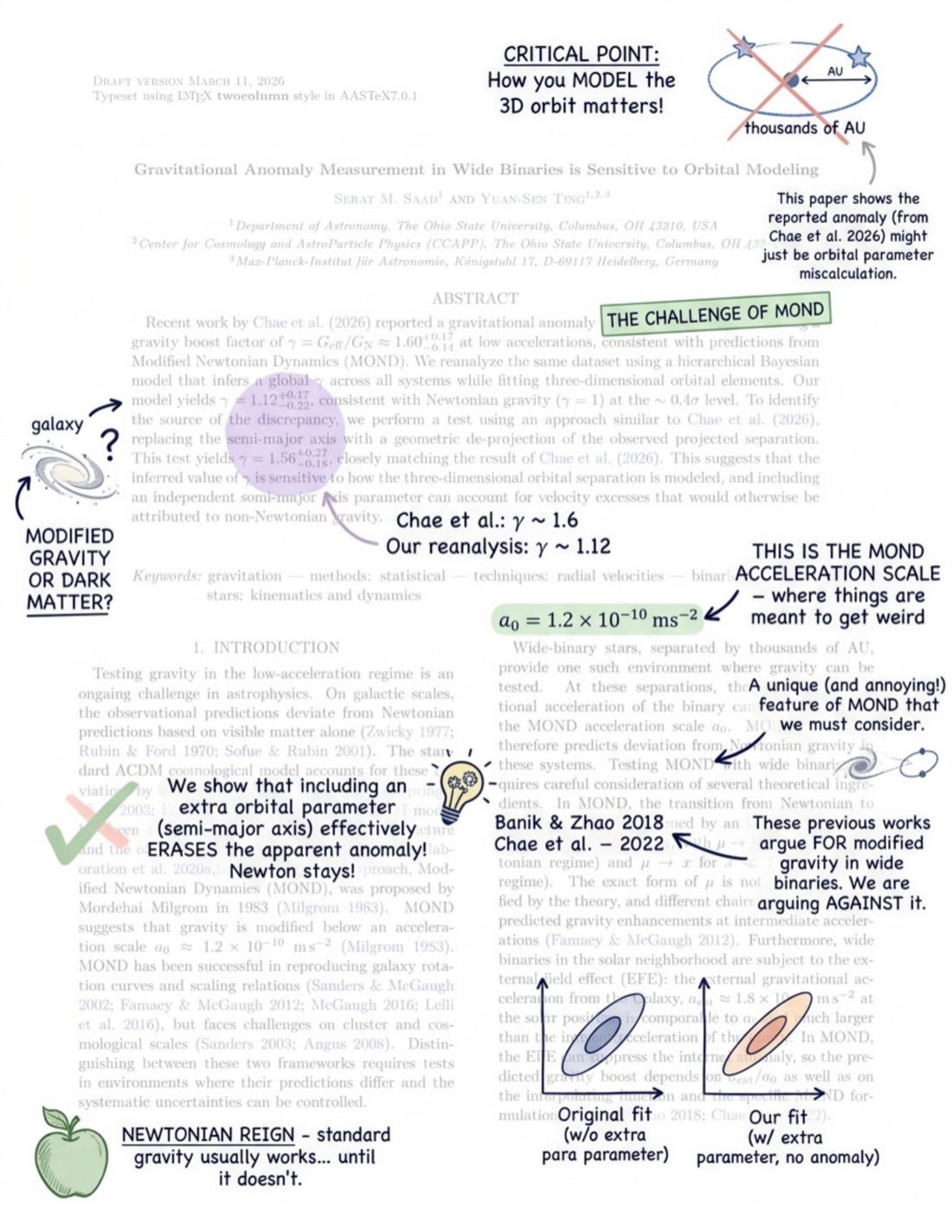
Recent work by Chae et al. (2026) reported a gravitational anomaly in 36 wide-binary pairs, finding a gravity boost factor of γ ≡ G_eff/G_N ≈ 1.60 (+0.17/−0.14) at low accelerations, consistent with predictions from Modified Newtonian Dynamics (MOND). We reanalyze the same dataset using a hierarchical Bayesian model that infers a global γ across all systems while fitting three-dimensional orbital elements. Our model yields γ = 1.00 (+0.24/−0.19), consistent with Newtonian gravity (γ = 1). To identify the source of the discrepancy, we perform a test using an approach similar to Chae et al. (2026), replacing the semi-major axis with a geometric de-projection of the observed projected separation. This test yields γ = 1.56 (+0.21/−0.18), closely matching the result of Chae et al. (2026). This shows that if the three-dimensional orbital separation is forward modelled using an independent semi-major axis parameter and then projected into the space of the observables, the relative velocities of wide binaries are consistent with Newtonian gravity.