Quantifying Bursty Star Formation in Dwarf Galaxies
Yuan-Sen Ting & Alexander P. Ji
The Open Journal of Astrophysics (2025), 8
Show abstract ▸Hide abstract ▾
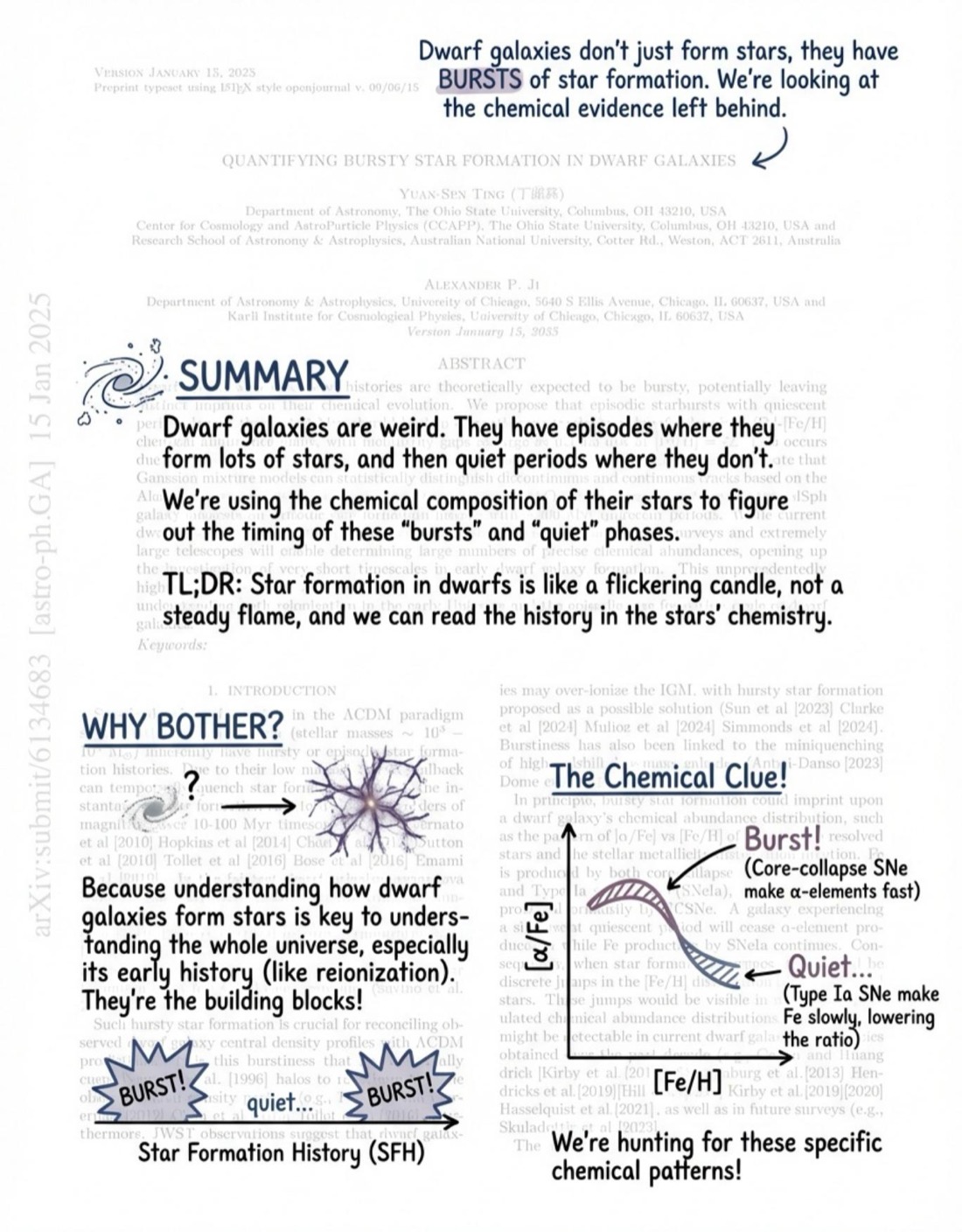
Dwarf galaxy star formation histories are theoretically expected to be bursty, potentially leaving distinct imprints on their chemical evolution. We propose that episodic starbursts with quiescent periods longer than ~100 Myr should lead to discontinuous tracks in a dwarf galaxy's [α/Fe]-[Fe/H] chemical abundance plane, with metallicity gaps as large as 0.3–0.5 dex at [Fe/H] = −2. This occurs due to continued Fe production by Type Ia supernovae during quiescent periods. We demonstrate that Gaussian mixture models can statistically distinguish discontinuous and continuous tracks based on the Akaike Information Criterion. Applying this method to APOGEE observations of the Sculptor dSph galaxy suggests an episodic star formation history with ~300 Myr quiescent periods.